
Initiatives to Improve Well-being
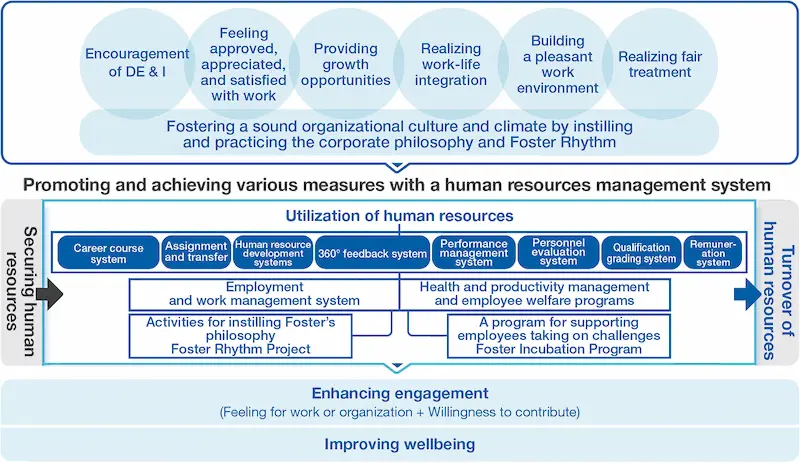
We respect the diversity of all of the employees working for Foster Electric and value the environment which enables them to choose their workstyles and careers. We have defined well-being as a state where employees can maintain and improve their physical and mental health while ensuring that their work enables them to develop personally, be satisfied in their jobs and take pride in their contributions to society. We are actively working towards this goal. The well-being we aim to achieve is a state where employee engagement has been improved and employees are motivated to take the initiative and are given opportunities for personal development. We aim to create an environment where working for Foster Electric contributes to the well-being of our employees.
1.Human Resource Development
Policies
Our human resource development is based on “continuous performance by linking various personnel systems with individual development goals determined by mid/long term business strategy and individual personality (strength/ weakness)”. We have formulated the Personnel Grand Design by viewing recruitment, development, utilization, assessment, and treatment organically and in an integrated manner from a long-term perspective, built a Personnel Framework that enables every employee to demonstrate their capabilities with pride and job satisfaction, and promote the development of human resources to solidify our human resource foundation for Foster Electric in the next generation.
Ideal for human resource development
- Personnel who embody our vision through their duties and who have a “strong will” and “initiative” to work toward their realization.
- Personnel who do not remain complacent about the current situation but utilize every opportunity to improve their own abilities and grow with ingenious attempts and efforts.
- Professional personnel who use their expertise to play a key part in strategy formulation and implementation and who can create value continuously.
- Self-directing personnel who are conscious about their expected and assigned roles and missions and who can take responsibility for their own actions and results.
Basic policy
Initiatives for independent career development
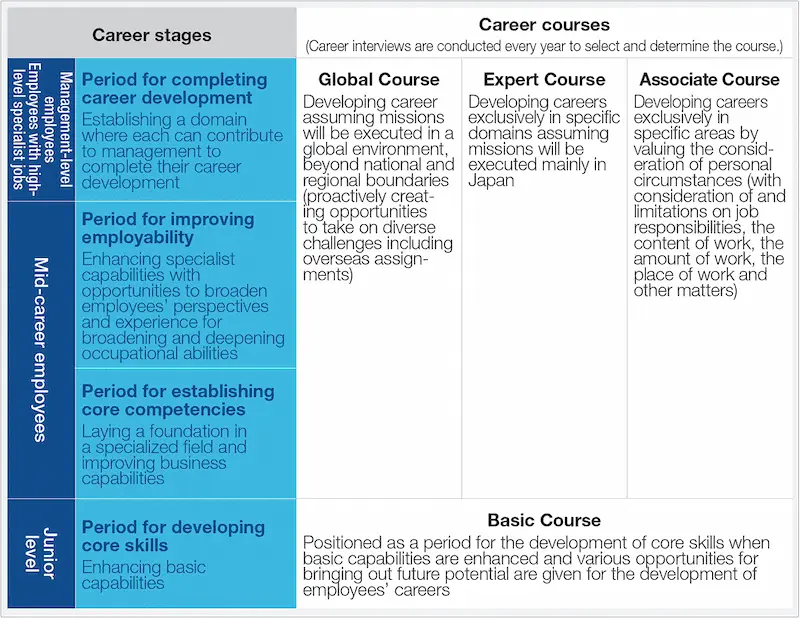
Employees’ voluntary initiatives shaping their careers are essential. Employees’ thinking about how they want to develop personally and the skills they need to acquire and acting accordingly will form the foundation of our human resource development and be a source of increased added value. We have established a career course system, which permits employees to choose options flexibly in accordance with the career plan and life stage of each, thus encouraging and helping employees to develop themselves independently under the system.
Initiatives for developing next-generation managerial human resources
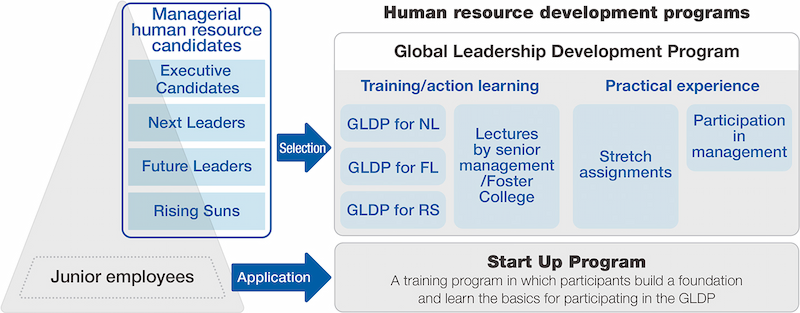
As part of our continuing strategies for developing managerial personnel, we implement the Global Leadership Development Program (GLDP) to globally foster human resources for the next and future generations.
The GLDP was developed based on a program for fostering managerial human resources that we began to fully implement in 2010. This program was rebuilt and newly systematized into the GLDP in 2019. Intended for personnel who are candidates for key posts, this program is implemented to individually develop the capabilities appropriate for each post.
In addition, in fiscal 2023, we introduced the Start Up Program, a development program that solicits participants from among young employees to develop future managerial human resource candidates.
Initiatives for developing globally competitive human resources
We operate systematic programs for developing globally competitive human resources, aiming for well-planned, ongoing development of human resources who understand diverse cultures and values and can demonstrate their capabilities at sites around the world.
The program for practical training at overseas factories, in which all new employees participate, forms the foundation of our development of globally competitive human resources. Through practical experience at overseas manufacturing sites, employees learn manufacturing processes, quality control, and initiatives for production innovation. They also have the opportunity to collaborate with colleagues from different cultural backgrounds. Acquiring this overseas experience at an early stage contributes greatly to fostering a global mindset, as well as a deep understanding of the essence of our manufacturing.
We also promote various forms of international employee reassignment, including the “Global-eye Program”, an overseas training program for junior employees, and the Overseas Trainee Program intended for mid-career employees. In doing so, we provide opportunities to accumulate more practical experience in overseas operations, as part of our efforts to develop the qualities of trainees as future global leaders. The focus of the training for newly promoted employees and manager training includes promoting understanding and practice of DE & I. We are instilling the understanding of the importance of building an organization which turns diversity into a strength, across the entire company.
With this multi-layered approach, we are striving to develop globally competitive human resources, who can demonstrate their capabilities at our sites worldwide, and increase our international competitiveness.s part of our continuing strategies for developing managerial personnel, we implement the Global Leadership Development Program (GLDP) to globally foster human resources for the next and future generations.
The GLDP was developed based on a program for fostering managerial human resources that we began to fully implement in 2010. This program was rebuilt and newly systematized into the GLDP in 2019. Intended for personnel who are candidates for key posts, this program is implemented to individually develop the capabilities appropriate for each post.
In addition, in fiscal 2023, we introduced the Start Up Program, a development program that solicits participants from among young employees to develop future managerial human resource candidates.
Initiatives for retaining young employees and developing young employees’ work-related skills as early as possible
We have established a comprehensive support system to assist the personal development of young employees multilaterally. In the Mentorship Program, senior colleagues serve as their close advisers and help them adapt to daily operations and the workplace environment. In the Mentorship Program by Officers, members of management directly interview young employees on a regular basis and give advice on career formation and long-term personal development. Further, in the Escort Runner Program, dedicated HR staff support young employees in the process of their development and provide them with comprehensive support throughout the process from workplace relationship-building to career planning. By having these programs work together, we have established a system for catering to the diverse needs of young employees and providing detailed assistance in their personal development.
Further, the Roundtable Meetings between Officers and Young Employees serve as valuable opportunities for direct dialogue between management and young employees. In these meetings, young employees can share with management the issues they encounter in daily operations and propose improvements, and engage in Q&A sessions about business strategies and the company’s vision for the future.
Initiatives for passing down skills and developing engineers
We have introduced the A La Carte Training as a program for the development of engineers. This permits participants to choose necessary courses from among approx. 45 courses, with a total length of more than 200 hours, in accordance with their needs. We have also built an environment which allows them to watch videos of classes that have been taught in the past.
The greatest features of this program are that the content of the program is optimized for the practical operations at Foster because all the lectures are given by internal staff and the internal lecturers are being developed continuously as the training is being provided to participants.
This initiative is improving our technological capabilities, facilitating the passing down of skills, and serving as the foundation for Foster’s reliable technological capabilities.
Having been introduced in 2011, more than 4,600 people have participated in this training program.
Initiatives for reforming the organizational climate
Based on the results of stress checks and the employee satisfaction/engagement survey which we conduct every year, we perform an organizational analysis to identify issues. In addition, in fiscal 2022, we introduced the 360° Feedback System which encourages managerial employees to self-reflect and change their behaviors, thus enhancing initiatives to build a better workplace environment.
In addition to the above, we have continued to identify issues based on various requests and recommendations received through labor-management consultations via the “Shinjukai,” an employee organization that is an alternative to a labor union, the results of exit interviews with people leaving the company, the results of employee questionnaire surveys conducted after interviews for providing feedback on personnel evaluations, and other channels, and we ensure personnel measures reflect these issues.
Initiatives for instilling the philosophy and improving engagement
We implement the Foster Rhythm Project globally to instill our corporate philosophy. In this project, we have redefined “the ideal company” for the Foster Electric and verbalized our principles and values, with employees themselves thinking on their own and generating ideas. We summarized these into a guidebook and a card and distribute them to our employees around the world. In addition, we continue to hold workshops and implement many training programs in our efforts to develop human resources who can embody our corporate philosophy and to create a lively organizational environment.
Further, the employee challenge support program (the Foster Incubation Program)* includes the production of short videos, FOSTER STORIES, as an initiative to tell the public about our strengths and appeal. These and other activities for improving engagement continue to spread and evolve.
-
*Foster Incubation Program (FIP) : An internal initiative launched in 2020.
In this program, employees themselves launch projects to do something exciting or take on challenges leveraging their ideas and skills, and support for these projects is provided to them.
2. Diversity, Equity and Inclusion (DE & I)
Policies
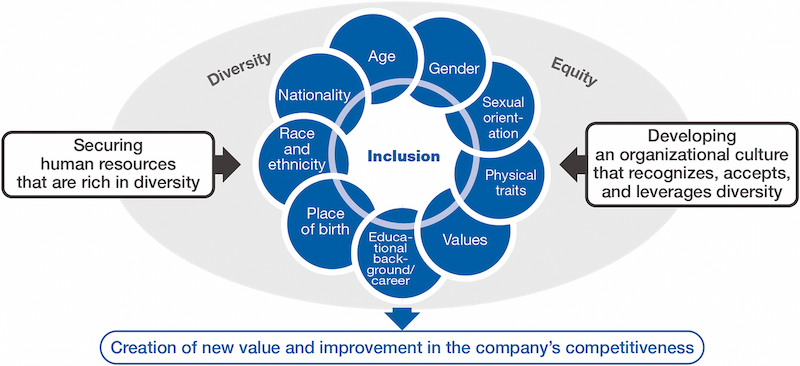
The co-creation of value with our diverse human resources through global cooperation is essential for our manufacturing.
We are driving the creation of an organizational culture that respects the diversity of various personal qualities, such as age, gender, sexual orientation, physical trait, values, educational background, career, hometown, race, ethnicity, and nationality, and which at the same time permits employees to work vigorously with a peace of mind by catering to diverse needs, including individual circumstances and life events such as childcare and nursing care. We aim to build a Win-Win relationship between the company and its employees and create synergies with the realization of enjoyable personal lives for each employee, the creation of new value, and improvement in the company’s creativity and competitiveness.
Activity Promotion Structure
We have established the Diversity Management Section, a dedicated organization for promoting diversity, equity and inclusion (DE & I), within the Human Resources Department.
Main Measures and Activities (Headquarters)
Educational activities on diversity
We have set up a special website on diversity on our internal intranet, where we provide various information to foster a better understanding of the fact that active participation of diverse human resources will lead to new value creation by the company. On this website, we are also raising awareness of inclusive language, which is aimed at promoting communications with respect for diversity. In 2018, we added “Actions for diversity that have been taken” to the personnel evaluation items. Further, in fiscal 2023, a lecture was held by our female director on the theme, “For each one of us to participate actively in our own way, let’s be aware of unconscious biases and take the first step toward changing our behaviors.” In fiscal 2024, we provided diversity management training for managers, in which trainees learned how to manage effectively while taking into account different individual attributes. We are working to create a more inclusive, diverse workplace by raising awareness of diversity among all employees and encouraging them to engage in self-driven activities.
Our activities for promoting understanding of LGBTQ+ (sexual minority)
We have been carrying out activities to deepen understanding of LGBTQ+ issues and promoting the number of allies (people who demonstrate their understanding and support for LGBTQ+ people). In fiscal 2023, we established the LGBTQ+-Friendly Promotion Committee to promote respect for people's sexual orientation and gender identity. We have introduced online training content, including a course for learning about LGBT to turn diversity into an organizational strength and a course for creating a harassment-free workplace. This training is available at any time.
Promoting women’s empowerment
Having set a goal of increasing the percentage of female managers to 30% by the end of fiscal 2025, we are developing female employees in a well-planned manner and supporting their career development. In fiscal 2022, we provided career training for young and mid-career female employees, in the form of lectures given by a female director. This training is aimed at deepening trainees’ understanding of diverse career options, so that they will have a clear picture of their career development, while building a network of female employees. In fiscal 2024, we held a roundtable meeting of female managers and female employees. During the session, the managers openly talked about the efforts they had made in their career development, what gives them job satisfaction as managers, and the creative measures they devised to balance work and private life, among other topics. Participants commented that they found the meeting meaningful because they could directly hear about things not typically discussed in day-to-day work.
Support for employees raising children and providing nursing care
To promote a working environment where employees who are raising young children or providing nursing care can work at ease, we have improved our system to support the balance between work and child care or nursing care. Since April 2018, we have extended the childcare leave period to three years maximum and the nursing care leave period to 183 days maximum. We have also expanded the range of employees eligible for sick/injured childcare leave from the those stipulated by law to all who are raising children who are junior high school students. We have also introduced an internal consultation service to provide appropriate advice and information individually. In fiscal 2023, we began providing an e-learning program titled “Nursing care seminar: living in the era of the 100-year lifespan,” and made it available at any time.
Initiatives for using senior human resources
We have a program under which employees who reach the mandatory retirement age of 60 years old can continue to be employed until the age of 65 (re-employment program).
Based on the idea that experienced senior human resources are an essential part of the Company’s workforce, we are building an environment that enables the active participation of these employees so that they can work proactively and remain motivated. While the working arrangements of senior human resources are determined individually based on organizational needs and other factors, we support diverse ways of working by providing flexible options regarding regular working days and regular working hours.o promote a working environment where employees who are raising young children or providing nursing care can work at ease, we have improved our system to support the balance between work and child care or nursing care. Since April 2018, we have extended the childcare leave period to three years maximum and the nursing care leave period to 183 days maximum. We have also expanded the range of employees eligible for sick/injured childcare leave from the those stipulated by law to all who are raising children who are junior high school students. We have also introduced an internal consultation service to provide appropriate advice and information individually. In fiscal 2023, we began providing an e-learning program titled “Nursing care seminar: living in the era of the 100-year lifespan,” and made it available at any time.
Initiatives for global human resource employment
We emphasize diversity in the employment of human resources as well. We are proactive in employing non-Japanese people to promote the globalization of human resources at headquarters, not to mention ensuring fair selection without discrimination. The percentage of overseas human resources among new graduates for the last fifteen years has been more than 20%. We are also emphasizing globalization in our mid-career hiring. In addition to recruiting human resources through conventional means, we are using diverse recruitment channels, such as establishing a program for employment transfer from overseas Group companies to headquarters in Japan. In doing so, we attract human resources with different nationalities and cultures to our organization, aiming to increase diversity and inclusiveness.
Reform of retirement pension plans
We worked on the reform of our retirement pension plans to expand options in response to the diversification of individuals’ life plans and to build a system that will enable stable pension payment into the future. As a result, in July 2022, we unified our retirement pension plans into the defined-contribution pension.
At the same time, we introduced the retirement benefit advance payment plan, which permits employees to receive advance payment of retirement benefits, to respond flexibly to needs associated with life events, such as their children’s education or the purchase of a home. The provision of these options also reflects the consideration we give to employees of non-Japanese nationality, whose future place of residence may not be Japan.
3.Labor (Labor Practices and Decent Work)
Policies
We believe it is important to create a worker-friendly environment where emphasis is placed on permitting each employee to achieve personal development through work and to demonstrate their capabilities while finding their job rewarding. We also seek to create an environment where employees with various backgrounds support each other spontaneously through daily communications and give ideas to each other. Under labor-management trust and mutual cooperation, we seek to create an organizational culture and develop various institutions, aiming to create an environment where employees with various lifestyles and aspirations can work in the style that suits their situation.
Activity Promotion Structure
In addition to the activities led by the Diversity Management Section, we have established the innovative working style project with cooperation between labor and management.
Main Measures and Activities (Headquarters)
Workstyle reform initiatives
Since September 2016, we have established the systems and culture that satisfy a variety of work-style to promote diversity and realize a work-life balance. In fiscal 2017, we applied the flex time system to all employees and introduced the work-at-home program. At present, we have fully introduced a work-at-home program without any limitations on eligibility.
In fiscal 2020, we reduced scheduled working hours per day by 15 minutes, to 7 hours and 30 minutes. At the same time, we enabled all employees to work using the flex time system without core time. We have engaged in creating a work environment where employees can work flexibly to suit their lifestyles regardless of time or place by fundamentally overhauling work procedures and utilizing ICT.
In fiscal 2021, we eliminated distance constraints to give employees more freedom to choose their place of residence. This has enabled us to respond flexibly to cases where an employee moves to a distant place due to the job relocation of their spouse.
We will continue to work on work-style reform to become a company that can offer a more desirable work environment and fulfilling career.
Initiatives to enhance the leave system and the leave of absence system
We are taking initiatives to enhance the leave system and the leave of absence system, aiming to promote the diversity of work styles, respond to diverse lifestyles, and improve working conditions.
We offer various leave systems, including the volunteer leave system, systems that grant a leave of absence to employees desiring to pursue further education and those who desire to accompany their spouses on overseas assignment. We also enhanced the Paid Leave Accumulation Program, which permits employees to accumulate expired annual leave, and offer familycare leave, leave for fertility treatment, and sick/injured child care leave. In addition, in July 2022, we introduced the Leave for Attending Child-related Event, so that employees can attend events such as their children's entrance ceremonies and graduation ceremonies without hesitation.
In addition, we introduced the semiannual day for company-wide paid leave and a monthly day to encourage employees take paid leave in our efforts to increase the paid leave acquisition rate. (Paid leave acquisition rate for fiscal 2024: 78.3% *Including five days of annual paid leave)
Initiatives for preventing overwork
Attaching importance to the medical knowledge that long working hours cause a decline in labor productivity and accumulation of fatigue and increase the risk of brain or heart failure, we are taking the following initiatives aimed at helping employees maintain good health and building a comfortable workplace environment.
- Company-wide application of the flex time system
We have introduced the flex time system without core time across the company, offering an environment where employees can adjust their work hours flexibly according to their workload and lifestyle. This system contributes greatly to business efficiency improvement and prevention of overwork.
- Expansion and enhancement of the work-at-home program
We had introduced the work-at-home program before teleworking became widespread. At present, we have removed the limit on the number of days worked at home and introduced a partial work-athome program that permits employees to work both in office and at home on the same work day. We have thus realized more flexible, efficient workstyles.
- Strategic encouragement of uptake of paid leave
Appropriate uptake of leave not only prevents overwork but also helps improve employee engagement and productivity. We have introduced a program that grants paid leave in a well-planned manner and set a monthly day when employees are encouraged to take paid leave, as part of our efforts to develop a workplace culture that facilitates the uptake of leave.
- Building an enhanced occupational health system
We have set our own monthly overtime limit of 45 hours, which is far below the statutory standard of 100 hours. Employees who exceed this limit are interviewed by our occupational doctors, who provide guidance. This is aimed at detecting mental or physical issues in the early stage and taking appropriate countermeasures. We have also established a system for consultation by occupational doctors, providing an environment where employees feel free to seek health advice.
We take these initiatives with the aim of helping employees maintain and enhance their mental and physical health and establish a sustainable workstyle.
Second job system
On September 1, 2020, we introduced a second job system. This reflects our belief that a wide variety of experience gained outside the company will increase opportunities to demonstrate one’s capabilities in new domains and achieve personal development, thus helping to increase the breadth and depth of career development of individuals. At present, more than ten employees are utilizing the second job system. They are broadening their perspective by doing work that they cannot experience in their primary jobs, thus acquiring diverse skills and expertise.
Health enhancement initiatives
Mental and physical health is essential for employees to feel job satisfaction and have a fulfilling career. We position employees’ health as an important management issue and are taking various initiatives. We have established a system where occupational doctors interview new employees after they join the company to ensure their mental health, and have enhanced health counseling services by occupational health nurses, in our efforts to prevent mental health problems and illnesses, detect them early, and prevent them from becoming severe. In addition, to raise employees’ health awareness, we implement the Health Point System. In this system, we give points to employees when they have received health examinations or comprehensive medical examinations, participated in mental health seminars, and received training related to mental health, for example, and provide them with health incentives. In fiscal 2024, we had occupational doctors provide mental health training, and trainees learned about mental health.
Our initiatives for improving employee health were evaluated and we received a “Certification of Excellent Company in Health: Gold Accreditation” from the Tokyo Promotion Council for Healthy Company Declaration in December 2018. (The certification was renewed on January 1, 2025.) In addition, in March 2025, we were certified under the Ministry of Economy, Trade and Industry’s 2025 Certified Health & Productivity Management Outstanding Organizations (Large Enterprise Category).
4.Safety and Health
Policies
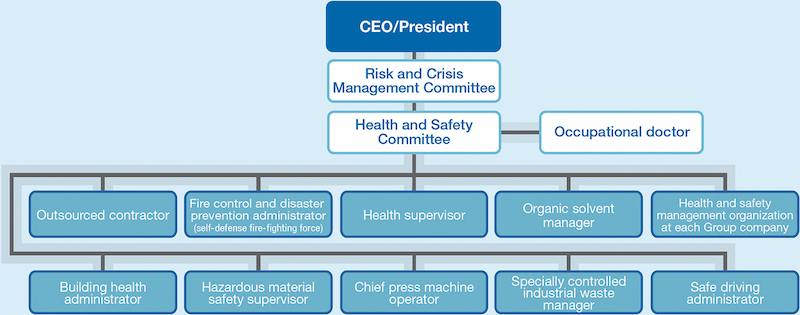
Foster Electric has established a principle to prioritize health and safety, and endeavors to create a safe and healthy working environment. Based on this principle, we deliberate on risks impacting all of our stakeholders, including employees and contractors, with the leading role played by the Health and Safety Committee and the health and safety management organizations at individual sites. Where necessary, risks are reported to the Risk and Crisis Management Committee, the upper-level organization, to coordinate with the Board of Directors, so as to facilitate activities to prevent health and safety risks in a company-wide manner.
Abstract from the Code of Conduct
- 1Understand laws and orders concerning work-related safety and health and emergency and comply with them. And minimize and prevent a recurrence of an accident in a reliable manner.
- 2Risks to workplace safety are managed through appropriate control measures, including preventive actions, workplace safety measures, ongoing training, and posting notices within the facility.
- 3Procedures and systems are to be in place to prevent, manage, track and report occupational injury and illness.
- 4Employee exposure to chemical, biological and physical agents is to be identified, evaluated, and controlled..
- 5Employee exposure to the hazards of physically demanding tasks is to be identified, evaluated and controlled.
- 6Production and other machinery is to be evaluated for safety hazards..
- 7Employees are to be provided with ready access to clean toilet facilities, canteen with suitable drinking and eating environment.
Activity Promotion Structure
The health and safety activities are operated by the Health and Safety Committee at headquarters in cooperation with occupational doctors, under the supervision of its upper-level organization, the Risk and Crisis Management Committee. By sharing information among the health and safety management organizations at each site, the Group is working as one to create an appropriate working environment.
Main Activities
Every year, we implement health and safety education, which is the basis of occupational activities. Further we tackle group-wide issues based around the Risk and Crisis Management Committee at headquarters. As part of the activities based on the Health and Safety Management Regulations, the health and safety management organization, which consists of representative workers and management, discusses issues specific to bases, conducts legal inspections, and confirms the implementation of risk assessments at each base to prevent accidents and eliminate risks for not only employees but all stakeholders including contractors and contract employees.
With regard to the group-wide issues, we take initiatives to resolve occupational health and safety issues and also address global health problems such as HIV/AIDS, tuberculosis, and malaria, by following the “Occupational Health and Safety Management Program Procedure Manual”, which is based on the “Foster Group Corporate Action Guidelines” and the “Foster Group Code of Conduct for Staff”. At headquarters, we have set a target of achieving zero occupational injuries by developing infrastructure and systems to reduce risks of occupational injuries, in line with the policy of the Health and Safety Committee, and have created a health and safety action plan. Based on this, we took steps to address the risks of occupational injuries and worked to achieve zero occupational injuries. As a result, none of the 21 occupational injuries that occurred within the Group as a whole were high-consequence work-related injuries.
Initiatives and achievements in Japan
- Implementation of a BCP drill and a fire evacuation equipment training session given by the local fire department following the completion of the new office in Osaka
- Provision of e-learning program on maintaining good health with a healthy diet to employees who are interested
- Remote traffic safety exercises by police officers from the local police department
- Activities by the chemical management promotion team and distribution of safety equipment to applicable employees, which were implemented in response to the legal revision
Promotion of chemical management
In Japan, we established a chemical management promotion team in response to the need to strengthen chemical management following the revision of the Industrial Safety and Health Act. We have strengthened our confirmation of labeling and creation of safety data sheets (SDSs) under the Globally Harmonized System of Classification and Labelling of Chemicals (GHS) and operations including the use of safety equipment. Based on risk assessments at each base, we took countermeasures centered around autonomous management. We have also established a system under which these activities are audited by the Health and Safety Committee.
Activities of the chemical management promotion team
- Promotion and implementation of chemical substance risk assessments
- Actions taken and promoted for the management of chemicals under the Industrial Safety and Health Act (including special rules)
- Actions taken and promoted for the use of personal protective equipment
- Appropriate management of SDSs and implementation of countermeasures based on assessment results
Bicycle safety
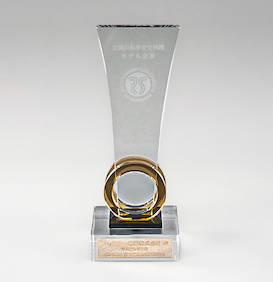
In recognition of our employees’ safe use of bicycles and our traffic accident prevention activities, we were certified by the Japan Traffic Management Technology Association as a Model Company for National Bicycle Safety in February 2017, with our activities being seen as making us a role model. The certification was again renewed fiscal 2024 in recognition of our continuing activities. We made it mandatory to wear a helmet when using a company-owned bicycle for work. We also hold internal lectures by local police officers as part of our efforts to ensure the safety of employees.
Initiatives in preparation for a Nankai Trough earthquake
Following the updated probability of a Nankai Trough earthquake, we reviewed our initial actions and systems at our sites in Japan, assuming the issuing of a warning. We implemented safety checks of our facilities, identified potential risks, and carried out improvement activities, considering not only an earthquake but also flooding and the eruption of Mt. Fuji. We are taking disaster control measures with an awareness of unexpected events.
Initiatives at overseas sites
We seek to improve areas related to health and safety at overseas plants and other overseas sites, either on our own or through externally certified management systems. We minimize the occurrence of work-related injuries and diseases with safe, hygienic work environments, in an effort to ensure high quality products and services and uniformity of manufacturing, retain workers, and increase their motivation to work. We also share information with employees and provide them with ongoing training, so as to identify and solve health and safety problems in workplaces.
Regarding the international standard ISO 45001 for occupational health and safety, the Bac Ninh Factory (Vietnam) and the Panyu and Heyuan Factories (China) received ISO 45001 certification in 2019, while the Ho Chi Minh Factory (Vietnam) became certified in 2022.
In addition, the ESTec Group, our subsidiary in South Korea, has also obtained this certification at its Ho Chi Minh Factory (Vietnam), Phu Tho Factory (Vietnam), Jiaxing Factory (China), and the headquarters factory (South Korea).
Among the 15 manufacturing sites of the Foster Group, the above eight sites have obtained the ISO 45001 certification and have continued to renew the certification every year.
At sites that have yet to obtain the ISO 45001 certification for occupational health and safety, we have stipulated that specific actions shall be taken by following “6.1.4 Planning Action” shown in the standard. We aim for appropriate operation based on the structure of each site.