
Relationship with the Supply Chain
Responsible Procurement
RespWe solve social issues through business and contribute to the development of society through sustainability initiatives based on our corporate creed, “Sincerity.”onsible Procurement
Representatives and Structures
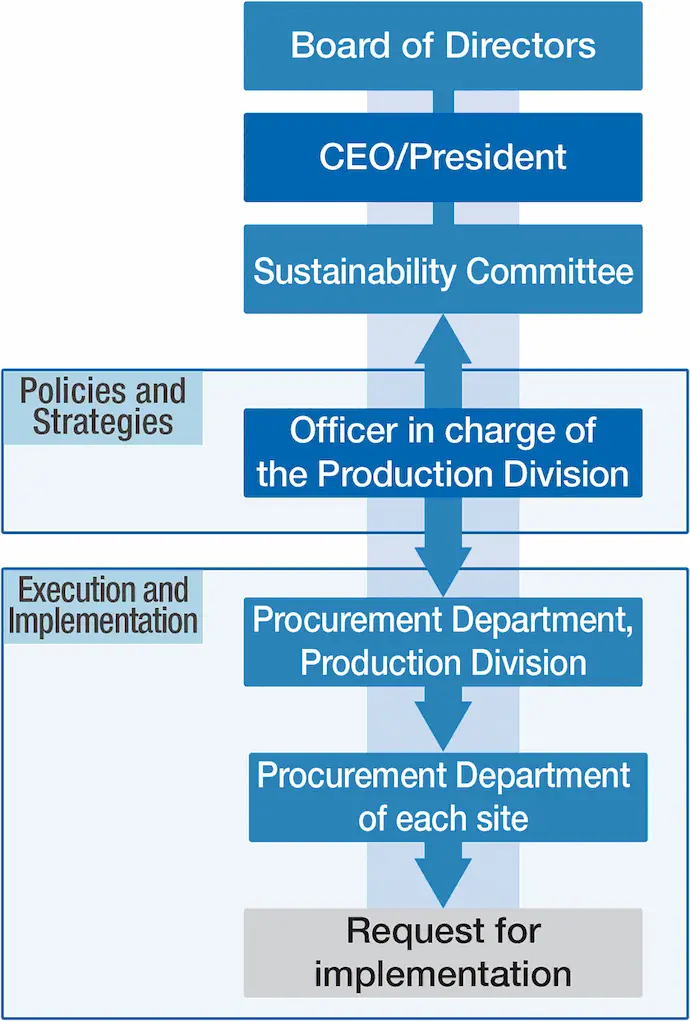
The Procurement Department belongs to the Production Division and performs activities under the head of the division (Director) as the repre-sentative. Each manufacturing site has a procurement department. We are promoting sustainability activities in a company-wide manner and enhancing the activities in cooperation with each manufacturing site.
We implement and manage basic policies and key sustainability issues by sharing information at Sustainability Committee meetings (held monthly), which are chaired by the CEO/President with core members representing related departments, global procurement meetings attended by representatives of the Procurement Department from all sites (held biannually), and the Global Procurement Conference, attended by our president, directors, and managers of our suppliers (held once every two years).
Initiatives to prevent bribery and conflicts of interest
The Foster Group Code of Conduct for Staff clearly prohibits bribery and acts of conflict of interest, for the purpose of maintaining sound relationship with suppliers. Specifically, we have set strict rules on the provision and acceptance of money and gift certificates, acceptance of gifts, as well as entertainment and other acts, in our efforts to ensure fair, highly transparent transactions.
Supply Chain Due Diligence
The Foster group conducts supply chain due diligence to ensure compliance with the Sustainability Code of Conduct. Our Code of Conduct is based on international standards and principles, such as the Responsible Business Alliance (RBA) Code of Conduct, the Automotive Industry Action Group (AIAG) and Drive Sustainability, and we request our suppliers to support them. The contents of the Sustainability Code of Conduct include matters regarding labor and human rights, health and safety, the environment, ethics, and management systems reflecting laws, ordinances and international norms.
To clearly express these requests, we have made it mandatory for our suppliers to agree to the Sustainability Code of Conduct before starting transactions with us. It is available in Japanese, English, Chinese, and Vietnamese on our website. When revisions are made, we distribute it to all suppliers, making sure they are informed of the updates.
Initiatives for Tier-2 and Lower-Tier Suppliers
We request that our suppliers inform our tier-2 and lower-tier suppliers of the requirements in the Sustainability Code of Conduct and have them confirm their compliance, in our efforts to ensure sustainable procurement activities throughout the entire supply chain.
CSR Self-assessments and Corrective Activities
To promote sustainable procurements in the supply chain, we request that our suppliers conduct CSR self-assessments. At the Foster Group, we use the CSR Procurement Self-Assessment Questionnaire prepared by the Global Compact Network Japan. The CSR self-assessments conform to international standards including the Ten Principles of the UN Global Compact, ISO 26000, and the GRI Standards. The self-assessments are made about a wide range of items, including corporate governance, human rights, labor, the environment, fair corporate activities, corrupt practices, quality and safety, information security, supply chains, and harmonious co-existence with local communities. Above all, we value the Ten Principles of the UN Global Compact. We confirm the status of compliance about the proper payment of wages, the fairness of work hours, and control of excessive work hours, among others, and request suppliers to build a system for corrective activities. Based on results of the self-assessments, we conduct audits, provide guidance for improvement actions, or implement awareness-raising activities as necessary. When a particularly problematic issue is identified, we suspend orders or take other punitive actions in accordance with the selection criteria.
Outline of Supply Chain
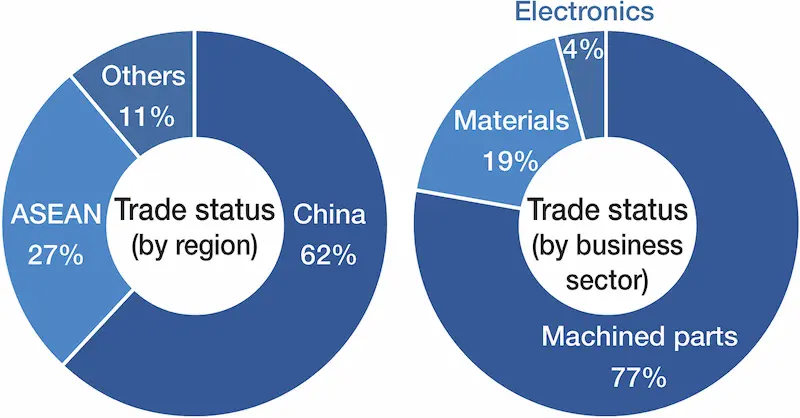
At Foster Electric, we carry out procurement activities globally and work together with our suppliers in each area to enhance sustainability. We procure a wide variety of parts and materials, ranging from raw materials to processed parts.
Results of CSR Self-assessments and Audits
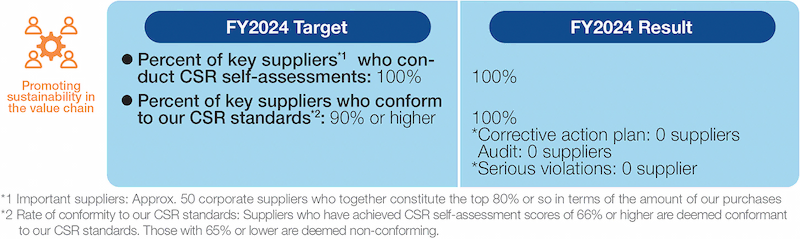
In fiscal 2024, we had all of our approx.300 suppliers conduct self-assessments, and no violations of standards were found. We will continue to request that suppliers conduct self-assessments regularly and take corrective action immediately if any problems are identified, in our efforts to build a sound supply chain.
Intra-Industry Collaboration (Engagement)
Since fiscal 2016, we have been a member of the Global Compact Network Japan (GCNJ), a network of the United Nations Global Compact (UNGC), and have engaged in the activities of the Supply Chain Subcommittee of the GCNJ. In this subcommittee, we have discussed the latest global supply chain trends, beyond the boundaries between industries, and the practical issues regarding sustainable procurement, and are improving CSR self-assessments.
In addition, because the number of minerals to be managed to ensure responsible minerals sourcing is increasing, we participate in the Outreach Meeting hosted by the Responsible Business Alliance (RBA) and explanatory meetings on responsible minerals sourcing hosted by the Japan Electronics and Information Technology Industries Association (JEITA), to ensure that information is shared regarding the latest trends and to develop intra-industry collaborations that raise awareness in the supply chain and improve the efficiency of investigations into these minerals.
Establishment of the Green Procurement Standard and Collaborations with Suppliers
We have established the Green Procurement Standard, in which we have summarized the environmental aspects of our requests for suppliers. Our Environmental Policy is to (1) contribute to the realization of a sustainable society by continually improving our environmental management systems, (2) establish a decarbonized society, (3) realize resource recycling, (4) be in harmony with nature and protect biodiversity, (5) comply with domestic and international environmental laws and regulations, and (6) develop human resources who can implement environmental activities through awareness-raising activities and training.
We have published the Green Procurement Standard on our website along with written instructions, submission forms, and other documents. We request that they are also shared with tier-2 suppliers.
In addition, we hold an environmental briefing remotely every year in Japan, China, and Vietnam, where we have our business sites. Approximately 300 people from our suppliers participate in the briefing, where we promote compliance with environmental regulations.
Responsible Minerals Sourcing
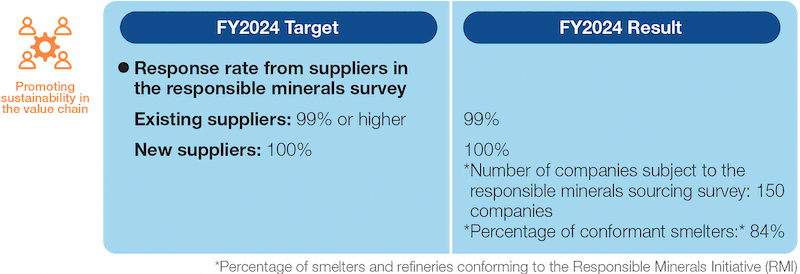
To promote responsible minerals sourcing, we implement initiatives in accordance with the OECD’s due diligence guidance, aiming to have all suppliers provide information from smelters and refineries via the supply chain. At the same time, we promote responsible minerals sourcing throughout the supply chain to fulfill our social responsibilities. If a mineral involved in a conflict or the infringement of human rights should be identified in our supply chain, we take measures to discontinue the use of the mineral, such as by changing the supplier.
Education
The Procurement Department provides education and training to learn about Foster Electric’s approach to sustainability and to acquire knowledge about compliance with the goal of developing human resources who can fulfill social responsibilities in its operations. We have developed a compulsory curriculum for employees in charge of procurement, which includes courses on the environment (the reduction of CO₂ emissions and environmentally hazardous substances), compliance (human rights and harassment), sustainability, and anti-corruption. In 2024, all Procurement Department employees took the required courses.
For raising awareness in the supply chain, we held a remote briefing on environmentally hazardous substances and sustainable procurement. The briefing was attended by 300 participants from 200 companies. For important suppliers, we hold a global supplier meeting every other year and explain recent sustainability-related trends, policies to be implemented in the future, and the things we requests of them to 150 participants from approximately 75 companies. We are thus implementing initiatives to build a sustainable supply chain.