
Sustainable procurement
- Foster Group's Initiatives for Sustainable Procurement
- Responsible Person and System
- Basic Policy
- Supply Chain Due Diligence
- Foster Group Supply Chain Code of Conduct
- Foster Group Human Rights Policy
- Supplier Selection and Important Suppliers
- Implementation of CSR Self-Assessment and Corrective Activities
- Initiatives for Suppliers' Second-Tier and Beyond
- Responsible Mineral Sourcing
- Industry Collaboration (Engagement)
Foster Group's Initiatives for Sustainable Procurement
Foster Group's sustainable procurement is based on its corporate motto, "Sincerity," and aims to realize a sustainable society throughout the entire supply chain. We promote the respect for human rights, improvement of labor conditions, environmental conservation, and ethical business activities, and are committed to procurement activities that fulfill social responsibility together with our business partners.
Responsible Person and System
Foster Group's sustainable procurement is promoted under a system where the Director in charge of the Manufacturing Headquarters is the responsible person. The basic policy and key priorities for sustainability are discussed by the Sustainability Committee, chaired by the President and CEO, and shared with all sites and business partners through the Global Procurement Meeting and Global Procurement Conference. The Head Office Procurement Department and the Procurement Departments of each manufacturing site work in close collaboration to develop sustainability activities across the entire global supply chain.
Basic Policy
To achieve sustainable procurement, Foster Group advances its activities on two levels: "Initiatives with All Business Partners" and "Initiatives with Important Business Partners."
For initiatives with all business partners, we request agreement to the "Foster Group Supply Chain Code of Conduct" and the implementation of a CSR Self-Assessment, making the fulfillment of basic requirements such as environmental management, quality control, and financial stability a condition of business.
For initiatives with important business partners, we evaluate them based on basic requirements such as transaction value, importance of procured items, and availability of alternatives, and then select important business partners from diverse perspectives, including geopolitical factors and QCDEST. With these partners, we aim to build a closer relationship and enhance the sustainability level of the entire supply chain.
Supply Chain Due Diligence
Our group implements supply chain due diligence to ensure compliance with the Sustainability Code of Conduct. Our Code of Conduct is based on international norms and principles such as the RBA (Responsible Business Alliance) Code of Conduct, AIAG, and Drive Sustainability, and we ask our suppliers to endorse them. Taking into account laws and principles of international norms, the content covers labor and human rights, health and safety, environment, ethics, and management systems.
To clearly communicate these requirements to our suppliers, we mandate agreement to the Sustainability Code of Conduct at the start of transactions, which is prepared in Japanese, English, Chinese, and Vietnamese and published on our website. Furthermore, upon revision, it is distributed to all suppliers to ensure thorough understanding.
Foster Group Supply Chain Code of Conduct
Based on the "Sustainability-Related Regulations" and the "Basic Policy for Materials and Procurement," we have established the "Foster Group Supply Chain Code of Conduct." We request our business partners to agree to this Code of Conduct at the start of transactions, and we regularly send the "Sustainability Code of Conduct Agreement" to investigate the status of their efforts.
Foster Group Human Rights Policy
Foster Group has established the "Foster Group Human Rights Policy" based on international and social norms and corporate ethics regarding human rights. Based on this policy, Foster Group's officers and all employees strive to protect and promote human rights and conduct business activities that respect human rights.
Supplier Selection and Important Suppliers
In the supplier selection process, efforts toward ESG (Environmental, Social, and Governance) are important evaluation criteria, in addition to financial status. For new and existing suppliers, the conclusion of a Basic Purchasing Agreement, which includes agreement to the "Sustainability Code of Conduct," is a mandatory certification requirement, along with the confirmation of financial evaluation, environmental management, and quality control systems.
Important suppliers are selected based on the following criteria:
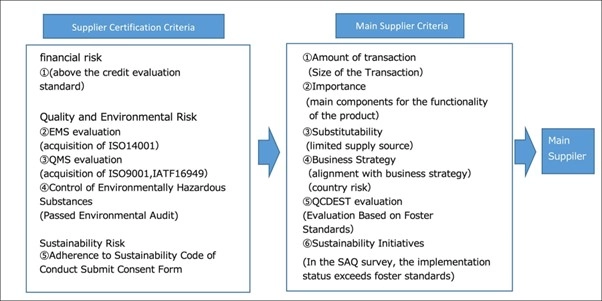
By strengthening business relationships with important suppliers and increasing the purchase ratio, we aim to effectively enhance the sustainability of the supply chain.
Implementation of CSR Self-Assessment and Corrective Activities
To promote sustainable procurement in the supply chain, we request the implementation of a "CSR Self-Assessment." Our group adopts the "CSR Procurement Self-Assessment Questionnaire" created by the Global Compact Network Japan.
This assessment is compliant with international standards such as the UN Global Compact 10 Principles, ISO 26000, and GRI Standards, and evaluates a wide range of items including corporate governance, human rights, labor, environment, fair business practices, corruption, quality and safety, information security, supply chain, and co-existence with local communities.
We particularly emphasize the 10 Principles of the UN Global Compact, confirming compliance with items such as payment of appropriate wages, application of fair working hours, and management of excessive labor, and also seek the establishment of a corrective mechanism. Based on the assessment results, audits, improvement guidance, and educational activities are implemented as necessary, and in cases where significant problems are confirmed, measures such as ordering a halt to transactions are taken in accordance with the selection criteria.
Initiatives for Suppliers' Second-Tier and Beyond
We require our suppliers to communicate the requirements of the Sustainability Code of Conduct to their second-tier and subsequent suppliers and to verify their compliance, thereby working toward the realization of sustainable procurement activities throughout the entire supply chain.
Responsible Mineral Sourcing
Foster Group has established a "Policy" for the international issue of responsible mineral sourcing. With the endorsement and cooperation of our business partners, we promote responsible sourcing activities as a member of the global supply chain.
Responsible Mineral Sourcing Policy
- Foster Group considers conflict minerals—such as tin, gold, tantalum, tungsten, cobalt, and mica mined in conflict-affected and high-risk areas, which may finance armed groups and be involved in risks like human rights violations (including child labor), poor forced labor, and environmental destruction—to be a serious social issue.
- We will implement initiatives in line with the OECD Due Diligence Guidance and establish a management process compliant with global standards, carrying out continuous efforts. We request our suppliers to source targeted minerals only from smelters and refiners that have been certified as not contributing to conflict or severe human rights abuses.
- To prevent our sourcing activities from financing armed groups or fueling conflict and human rights abuses, we incorporate this into the "Foster Group Supply Chain Code of Conduct" and promote it as part of our sustainability promotion activities.
- We do not believe that simply avoiding sourcing from conflict-affected and high-risk areas will solve these problems, and we must take care not to prohibit the sourcing of conflict-free minerals located in those regions.
- Cooperation throughout the supply chain, from upstream to downstream, is essential for this initiative. We request information provision from all relevant business partners and aim to source from certified conflict-free smelters/refiners.
Inquiries regarding Responsible Mineral Sourcing
Contact
- *This is the dedicated contact point for inquiries regarding responsible mineral sourcing.
Industry Collaboration (Engagement)
Since fiscal year 2016, Foster Group has been a member of the Global Compact Network Japan (GCNJ), a network of the United Nations Global Compact (UNGC), and participates in the Supply Chain Sub-committee activities. We discuss the latest trends in the global supply chain that transcend industry boundaries, as well as practical issues related to sustainable procurement, and are working to improve the CSR Self-Assessment.
Furthermore, in response to the increase in regulated minerals for responsible mineral sourcing, we participate in Outreach Meetings hosted by the Responsible Business Alliance (RBA) and Responsible Mineral Sourcing Briefings hosted by the Japan Electronics and Information Technology Industries Association (JEITA). We promote the sharing of the latest trends and supply chain awareness activities through industry collaboration, and strive to improve the efficiency of surveys.