Information Disclosure Based on the TCFD Recommendations
Recognizing the importance of topics related to the environment and climate change, we declared our support for the recommendations of the Task Force on Climate-related Financial Disclosures (TCFD*) in February 2022. At the same time, we joined the TCFD Consortium, where member companies, financial institutions, and other entities discuss effective information disclosure and appropriate initiatives following the TCFD recommendations.
We will identify our climate change-related risks and opportunities and then continue to drive effective measures by leveraging internal and external knowledge. At the same time, we will disclose information proactively by following the TCFD recommendations.
- *Task Force on Climate-related Financial Disclosures: This task force was established in 2015 by the Financial Stability Board (FSB), which comprises central banks, financial authorities, and international organizations from all over the world. It is aimed at considering how to estimate the impact of climate change on business management and how to disclose such information. It recommends that companies and other entities disclose information about climate change-related risks and opportunities.
1.Governance
Viewing sustainability as an important theme, we established our ESG Management Statement in March 2021. We set response to climate change as part of our materiality. These goals and reduction activities have been shared by all employees and are being driven by them.
The Sustainability Committee, which is chaired by the president, meets every month for the purpose of driving ESG management. This committee meets with the attendance of the sustainability officer, heads of divisions, and persons responsible for the promotion of sustainability activities appointed by departments of the headquarters and overseas bases. It identifies climate change-related issues, deliberates on and determines related policies and measures, and shares and monitors their progress.
The Board of Directors deliberates on and makes decisions on announcements of support and information disclosure related to TCFD concerning management issues, as well as reduction targets, measures, and other matters. It also receives reports on deliberations and progress made by the committee, regularly and as needed, thus supervising the committee's execution of operations.
2.Strategy
Under the framework advocated in the TCFD recommendations, we considered changes in the external environment in 2030 and analyzed the impact of climate change on us.
We adopted the 1.5-degree and 4-degree scenarios for analyzing risks and opportunities. Regarding transition risks, we considered how policies and markets will change for the alleviation of climate change. Concerning physical risks, we also analyzed how the frequency and impact of climate change-related weather disasters will change.
We reflected the identified risks and opportunities in the medium-term business plan. Moving forward, we will also consider the financial impact on the Company. We are conducting an analysis of the part of the automotive business, which is subject to a significant impact. We will continue the analysis by focusing on other businesses as well.
Impact on Business Related to Climate Change Risks and Opportunities
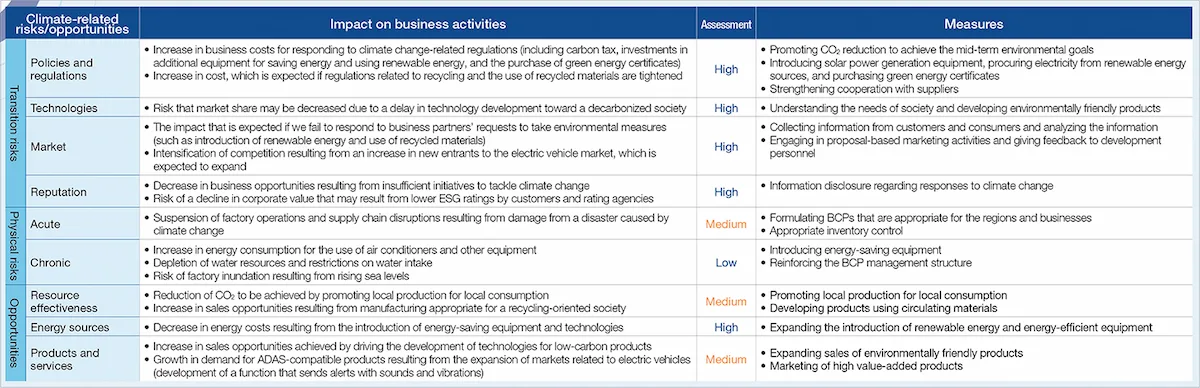
- Target business: Automotive as the Company's main business
- Level of impact on business activities: Evaluated on a three-point scale of Large, Medium, and Small
[Scenarios that were used]
Transition risks: International Energy Agency (IEA)*1
- World Energy Outlook 2022:APS*2, STEPS*3
- Net Zero Emissions by 2050 Scenario*4
Physical risks: Intergovernmental Panel on Climate Change (IPCC)*5
- 6th Report: SSP1-1.9, SSP5-8.5 *6
- *1IEA: International Energy Agency
- *2APS: Announced Pledges Scenario
- *3STEPS: Stated Policies Scenario
- *4NZE: Net Zero Emissions by 2050 Scenario
- *5IPCC: Intergovernmental Panel on Climate Change
- *6SSP: Shared socioeconomic pathways
3.Risk Management
We have established the Risk and Crisis Management Committee, which is chaired by the president, to ensure that risks which may affect business management are addressed promptly and appropriately. This committee evaluates and manages company-wide risks and devises and implements measures to address them.
Especially, climate change-related risks are positioned among the top risks in the committee's total risk assessment. The Sustainability Committee identifies and evaluates such risks, implements measures to tackle them, and takes other initiatives to improve the effectiveness of risk management.
Information about the statuses of risk management and measures is also shared with the Board of Directors, which supervises and monitors risk and crisis management of the overall company and tries to ensure consistency between risk management and materiality analysis, thus enhancing the total risk management in the entire company.
4.Metrics and Targets
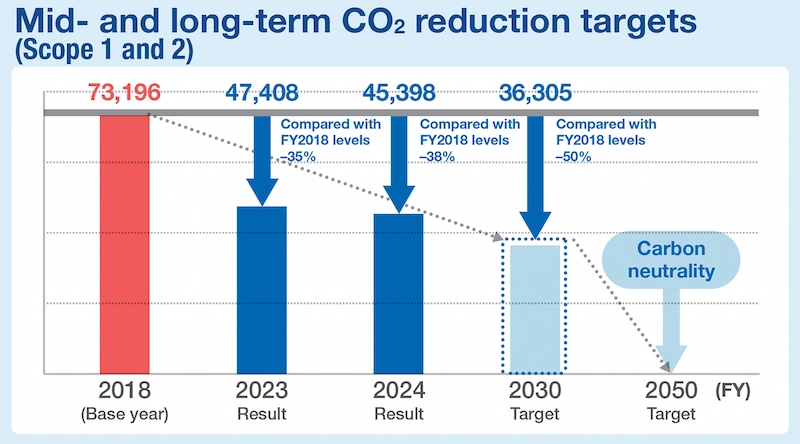
We revised our CO2 emissions reduction targets in 2021. The revised mid-term goals are to reduce absolute Scope 1 and 2 emissions 50% by 2030 from a FY2018 base year and to reduce absolute Scope 3 emissions 15% by 2030 from a FY2018 base year. We also set a new long-term goal of achieving carbon neutrality by 2050. We are actively promoting initiatives to achieve the reduction.
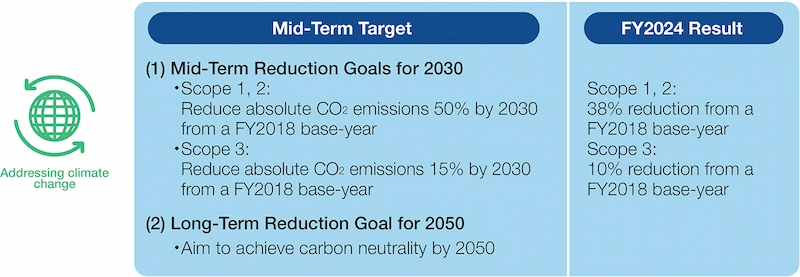
To achieve this goal, we have developed the CO2 Reduction Action Program [Ver. 2025]. The headquarters and the other sites will work together in accelerating CO2 reduction activities in a group-wide manner.
Specific Reduction Measures
- 1Our own power-saving efforts (steady efforts and innovative activities)
- Steady efforts
Specific measures:- Operational improvements: Improvements of operation, maintenance, heat retention, heat insulation, etc.
- Introduction of energy-saving equipment: Remodeling or replacing equipment
- Innovative activities
Activities:- Studying and introducing new manufacturing methods and design specifications Specific measures:
- Developing innovative technologies through a next-generation speaker project, etc.
- Steady efforts
- 2Renewable energy procurement
- Switching electricity purchased from electric power companies to an option with 100% renewable energy sources
- 3In-house power generation from renewable energy sources
- Introducing equipment for in-house solar power generation
- 4Purchasing green energy certificates for offsetting (shortfalls)
- Purchasing green energy certificates for overseas factories
Specific KPIs
At each site, we have set electricity consumption as a KPI for reduction and are pursuing well-planned energy-saving initiatives. We are committed to achieve the FY2030 goals of reducing absolute Scope 1 and 2 emissions (by 50% from a FY2018 base year) through these activities.