
Corporate Governance
Policies
To maximize our corporate and shareholder values, we recognize the importance of establishing a fair and sound corporate management system and a managerial structure that enables quick and accurate decision making to accommodate an ever-changing business environment, and the execution of legitimate and appropriate business operations. To that end, we are working to improve and enhance our approach to corporate governance.
Corporate Governance Structure
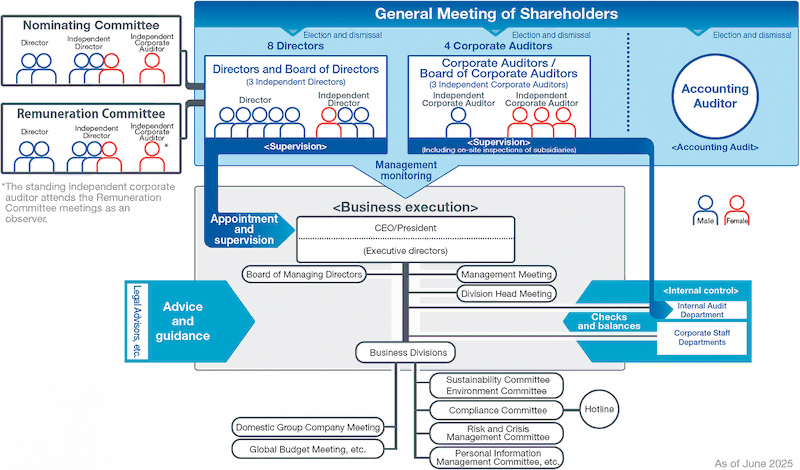
Board of Directors
The Board of Directors meetings are held regularly on a monthly basis, in principle, and whenever necessary to discuss and decide important agenda items and the execution of important business concerning the Group’s management policies and strategies. It also supervises the management from an independent and objective standpoint.
- Members of the Board of Directors and their attendance at its meetings
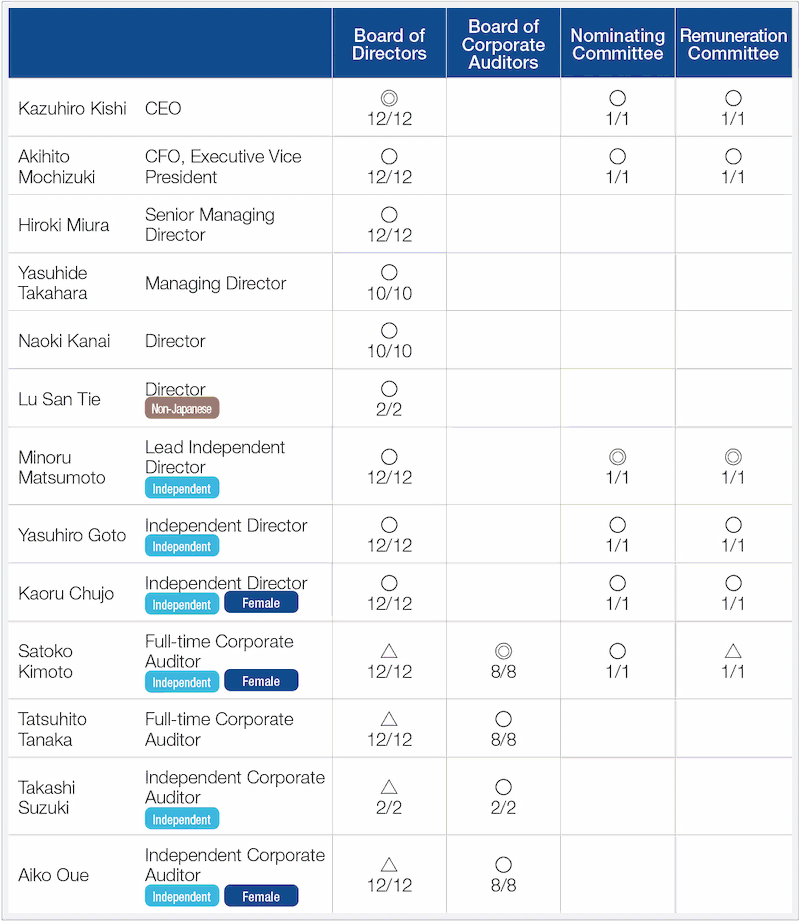
The Board of Directors meeting currently consists of eight directors and four corporate auditors present. Seven of the meeting attendants (three independent outside directors and four corporate auditors), who constitute the majority, are in a position to supervise or audit management from an independent standpoint. In addition, the Board of Directors is chaired by the president. Because we are in a period of business transformation, with many agenda items related to important business execution, we believe that the smooth operation of the Board of Directors is enabled by having the president, who is familiar with the status of business execution and the internal situation, host the meetings as the chair. In addition, sessions for exchanges of views between directors, which are hosted by independent directors, are held to increase the effectiveness of the Board of Directors. Members of the Board of Directors and their attendance at its meetings are as shown in Table 1.. - Major matters considered by the Board of Directors
The Board of Directors vote on important matters related to business execution, including management policies, business plans, and sustainability-related issues, in addition to agenda for the general meeting of shareholders and legal matters for resolution. Progress in important matters of business execution is also reported. Matters to be reported include those requested at sessions for exchanges of views between independent directors and corporate auditors and among independent officers, leading to a lively exchange of opinions.
Board of Corporate Auditors
Corporate auditors attend the Board of Directors meetings and other important meetings to audit the execution of duties by following audit standards, policies, and other rules set by the Board of Corporate Auditors.
- Members of the Board of Corporate Auditors and their attendance at its meetings
The Board of Corporate Auditors consists of four members (including three independent corporate auditors). Each auditor has considerable knowledge in accounting, tax affairs, or legal affairs. Members of the Board of Corporate Auditors and their attendance at its meetings are as shown in Table 1. - Major matters considered by the Board of Corporate Auditors
They include audit policies, the legality of business reports and annexed detailed statements, the legality of the execution of duties by directors, the internal control system and its status of operation, and the reasonableness of the methods and results of audits conducted by the accounting auditor.
(Note)
1. Mr. Yasuhide Takahara was appointed as Managing Director at the 90th Ordinary General Meeting of Shareholders of the Company that was held on June 26, 2024.
2. Mr. Naoki Kanai was appointed as Director at the 90th Ordinary General Meeting of Shareholders of the Company that was held on June 26, 2024.
3. Mr. Lu San Tie resigned at the close of the 90th Ordinary General Meeting of Shareholders of the Company that was held on June 26, 2024.
4. Mr. Takashi Suzuki resigned at the close of the 90th Ordinary General Meeting of Shareholders of the Company that was held on June 26, 2024.
Status of Activities of the Nominating Committee
The committee is chaired by the lead independent outside director and its members are three independent directors, two directors, and the independent corporate auditor.
To ensure the fair, transparent selection and appointment, etc. of officers (directors and corporate auditors), the committee drafts agendas on appointment or dismissal of directors and corporate auditors that the Board of Directors submit to the general meeting of shareholders, as well as agenda items on the appointment or dismissal of the president for the Board of Directors meetings. In the process of appointing the president, the committee has the authority to select a succession plan and candidates and interview the candidates.
- Discussion of specific criteria for the selection of CEO candidates
- Interviews with CEO candidates
- Selection of CEO candidates
- Selection of candidates for directors and corporate auditors to be submitted to the 91th Ordinary General Meeting of Shareholders and submission of the candidates to the Board of Directors and the Board of Corporate Auditors
The status of attendance of each member is as shown in Table 1.
Status of Activities of the Remuneration Committee
The committee is chaired by the lead independent outside director and its members are three independent directors and two directors. The independent corporate auditor also attends its meetings as an observer.
This committee has the authority to determine the director remuneration system, criteria, and policies and content of remuneration of individual directors, within the amount limits set by resolution by the general meeting of shareholders and within the scope specified in internal regulations on remuneration, so as to ensure fair, transparent decisions on directors' remuneration, their treatment, and other areas.
- Review of business performance of the overall company and each division in the last fiscal year
- Evaluation of individuals based on the above for performance-linked remuneration for the fiscal year
- Review of the progress of the mid-term business plan and evaluation of mid- to long-term performance based on the above
- Evaluation of individuals for performance-linked remuneration
The total amount of remuneration of directors was submitted for discussion at the Board of Directors meeting held on June 25, 2025 and received approval. Regarding the amount of remuneration of each director (and each executive officer), it was resolved that the Board of Directors would leave the decision to the committee within the total amount and the scope set forth in the internal regulations on remuneration of directors, etc.
The status of attendance of each member is as shown in Table 1.
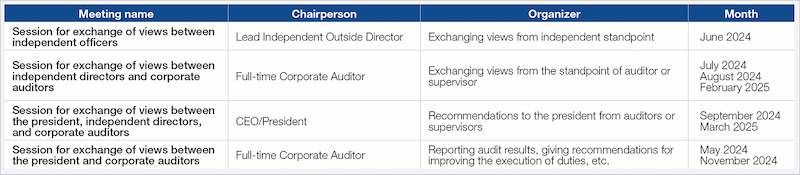
Sessions for Exchange of Views between Officers
We hold the following sessions for exchanging views for the purpose of strengthening corporate governance. At each session, attendants have unrestricted, constructive discussion and exchange of views, including the presentation of problems. The content is utilized for the discussion and operation of the Board of Directors, supervision of management, business execution, and other purposes.
Evaluation of Effectiveness of the Board of Directors
To increase the effectiveness of the Board of Directors, we evaluate its effectiveness based on questionnaires filled out by directors and corporate auditors. We also use the results of the surveys in the operations of the Board of Directors.
Overview of results of the effectiveness evaluation of the Board of Directors
-
1Last fiscal year (FY2024)
-
1Composition
The Board of Directors has a well-balanced composition, with internal and external officers with diverse experience and insights. Its size is appropriate for having sufficient communications and lively discussions. Meanwhile, appointing directors with expertise in investor perspectives, technology and R&D, and comprehensive strategic judgment, as well as recruiting foreign nationals, remain challenges for the future. -
2Status of operation
To help the Board of Directors conduct meaningful discussions, materials are distributed to its members before a meeting is held, thus having them understand the background, purpose, and content of each agenda. In addition, where necessary, explanations are given by the secretariat to the Board of Directors or others. The set frequency of meetings is also appropriate. While improvements have been made in the early presentation of materials, there is room for improvement in the earlier provision of materials and prior explanations to outside officers. In addition, in the case of an important matter, holding repeated deliberations, such as holding an extraordinary meeting of the Board of Directors without waiting for a regular meeting, will further vitalize the operations of the Board of Directors. -
3Status of deliberations
As a result of the extended duration of each Board of Directors meeting, effectiveness has been increased with more thorough explanations of each agenda item, sufficient time provided for questions, answers and discussion, and unrestricted, constructive discussion and exchanges of views, among other improvements. Moving forward, deliberations need to be enhanced by checking the actual conditions and situation of businesses at each overseas site, and discussion of important matters, such as the mid-term business plan, needs to be enhanced.
-
1Composition
-
2Future initiatives
In light of the results of evaluation for the last fiscal year, the following initiatives will be taken in an attempt to enhance deliberations by the Board of Directors and further increase its effectiveness.
- Presenting materials earlier, ensuring the early provision of materials about important matters, and improving prior explanations about such matters
- Enhancing deliberations of management strategies and important matters and follow-up reporting
- Enhancing deliberations by checking the actual conditions and situation of businesses at each overseas site
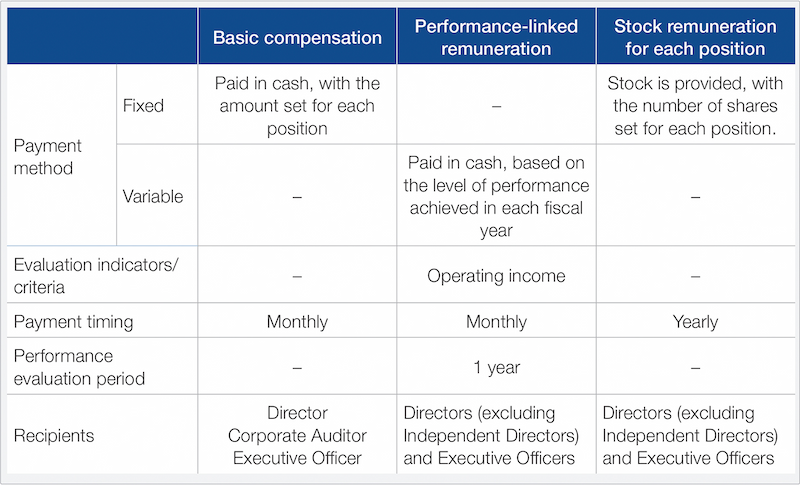
Overview of Officer Remuneration System
The remuneration of directors and corporate auditors is paid in such a way that the amount will not exceed the limit on remuneration, a resolution on which was passed at the general meeting of shareholders.
Regarding the remuneration of directors, the remuneration system, criteria, and policies and content of remuneration of individual directors are determined by the Remuneration Committee so as to ensure fair, transparent decisions on directors’ remuneration, their treatment, and other aspects.
The remuneration of internal directors consists of the basic remuneration, performance-linked remuneration, and stock remuneration for each position. The system, criteria, and policies for the remuneration of corporate auditors and the contents of remuneration of individual corporate auditors are determined by the Board of Corporate Auditors.
Corporate Governance Guidelines
The Foster Group has established Corporate Governance Guidelines that express our basic way of thinking and framework with regard to corporate governance.
Foster Group Corporate Action Guidelines
The Foster Group has established Corporate Action Guidelines that express our actions with public decency in compliance with laws and regulations inside and outside Japan, international rules, and their spirit and intent as well as corporate ethics.