
Material issues
Identification of Material Issues
We revised our ESG-related material issues in 2024 to respond to changes in the business environment and the growing demand for the transparent disclosure of information. Specifically, we analyzed and evaluated the financial, social and environmental aspects of our material issues.
We adopted the double materiality concept to identify priority issues from two perspectives: the impact of the company on society and the environment, and the impact of social and environmental issues on financial performance. We clarified our priority issues based on the reasons identified during the analyses. In addition, to ensure alignment with our management strategies, we incorporated the direction of our management policies and the midterm business plan into our existing ESG-related material issues, adding the Business (B) aspect, and identified issues in the B+ESG fields. Accordingly, we will implement initiatives with both management and sustainability at our core to enhance our corporate value and continue to strengthen and promote our long-term growth strategies.
Process of Identifying Material Issues

Value chain survey
Identifying issues by clarifying the relationships between business, society, and the environment throughout the value chain

Stakeholder survey
Identifying issues by analyzing the issues, concerns, and expectations by major stakeholders
Understanding megatrends
Identifying issues by analyzing megatrends that will cause great change in the future business environment (in the period up to 2040)
Management and business analyses
Identifying issues connected to our future plans by analyzing internal documents including management policies and the Internal survey mid-term business plan
Understanding megatrends
We organized and consolidated the identified issues and then had team members from different departments evaluate the degree of “the company’s impact on society and the environment (Impact)” and “the impact of social and environmental issues on financial performance (Risks and Opportunities)” from the perspectives of scale, probability of occurrence, and other factors.

Finalization of material issues
The Board of Directors deliberates the matter and approves the list of material issues after it is reviewed by the Sustainability Committee, which consists of staff members and managers in each of the B+ESG fields.
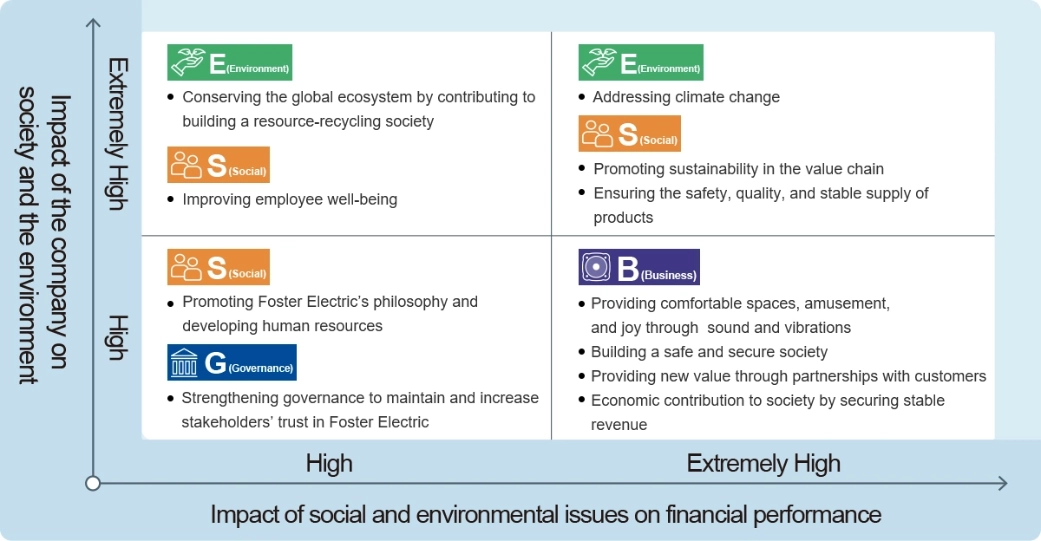
Our Material Issues
B(Business)
- Materiality (Priority Issues)
-
- Reason for selection
Set as our Vision, this is one of our most fundamental themes. Achievements from initiatives in this field are important for creating future business opportunities, including Foster Electric’s potential expansion into other businesses. They also directly impact profit.
- Materiality (Priority Issues)
-
- Reason for selection
With the popularization of next-generation automobiles such as EVs and HVs, demand for speakers for Acoustic Vehicle Alerting System (AVAS) is growing rapidly. It is expected they will contribute to society in terms of traffic safety. At the same time, this is an important field for the expansion of our businesses, including our OEM business, and for increasing revenue from one of our core product lines.
- Materiality (Priority Issues)
-
- Reason for selection
With the popularization of next-generation automobiles such as EVs and HVs, demand for speakers for Acoustic Vehicle Alerting System (AVAS) is growing rapidly. It is expected they will contribute to society in terms of traffic safety. At the same time, this is an important field for the expansion of our businesses, including our OEM business, and for increasing revenue from one of our core product lines.
- Materiality (Priority Issues)
-
- Reason for selection
We understand that securing stable revenue makes it possible to appropriately return profits to our shareholders, and it also contributes to the economies of the local communities in which we operate around the world.
E(Environment)
- Materiality (Priority Issues)
-
- Reason for selection
With the intensification of natural disasters caused by climate change, there are concerns regarding risks of society and the supply chain being disrupted. This has made it even more important than ever to reduce greenhouse gas emissions from the entire value chain and take additional measures to address climate change. In addition, we understand that fulfilling the demand for environmentally friendly products, which is growing mainly in Europe, is an important initiative in the era of the circular economy.
- Materiality (Priority Issues)
-
- Reason for selection
The use of chemical substances and water resources as well as the generation of waste at factories increases their environmental impact, and may affect local ecosystems, creating legal and social risks. Further, while demand for the use of recycled materials is rising particularly in Europe, actions to support a circular economy are essential for the future sustainability of the business.
S(Social)
- Materiality (Priority Issues)
-
- Reason for selection
Promoting Foster Electric’s philosophy and developing human resources forms the foundation of our creation of value and competitiveness, significantly impacting the company’s growth and sustainable management over the mid- to long-term. We also understand that handing down the skills of our globally competitive talent and the development of these human resources are important for our future growth.
- Materiality (Priority Issues)
-



- Reason for selection
Improving employee well-being (good physical and mental health as well as happiness) has a positive impact on the company in various ways, such as by improving productivity, decreasing the turnover rate, increasing employee retention, and increasing innovation. We aim to improve employee well-being by increasing employee engagement through efforts such as workstyle reform, DE&I, safety and health and other initiatives to motivate employees to take the initiative and by providing them with opportunities for personal development.
- Materiality (Priority Issues)
-
- Reason for selection
In recent years, the management of risks throughout the value chain, including risks related to human rights and environmental considerations, has grown more important than ever. The importance of risk management is continuing to increase for manufacturers who have broad-ranging supply chains, like Foster. They must act responsibly in every process, from upstream to downstream. Requests and survey inquiries from our business partners have been increasing and growing more sophisticated. This has made it essential for us to develop an internal system for responding to them appropriately and promptly as a company.
- Materiality (Priority Issues)
-
- Reason for selection
Ensuring the safety and quality of our automotive products is a top priority, because these products are directly linked to human lives. In addition, because our supply of products directly affects customers’ production lines, it is essential that we build a system that enables us to respond promptly to unforeseen circumstances, such as rises in the prices of materials or social disruptions in the countries where the materials are procured.
G (Governance)
- Materiality (Priority Issues)
-
- Reason for selection
An incident involving inappropriate corporate governance may not only affect our evaluation but also impact our shareholders, customers, suppliers and other stakeholders in wide-ranging way. This makes it vital for us to fulfill our social responsibilities as a company by complying with laws and regulations and ensuring that we appropriately disclose information.
Our Approach to Materiality (Priority Issues)
B(Business)
| Material issues | Subordinate issues | Target (KPI) | Achievements until FY2024 |
|---|---|---|---|
 Providing comfortable spaces, amusement, and joy through sound and vibrations
|
- | - | Because the new mid-term business plan was launched in April 2025, achievements under the plan have not yet been reported at this stage. |
 Building a safe and secure society
|
- | - | |
 Providing new value through partnerships with customers
|
- | - | |
 Economic contribution to society by securing stable revenue
|
- | - |
E(Environment)
| Material issues | Subordinate issues | Target (KPI) | Achievements until FY2024 |
|---|---|---|---|
 Addressing climate change
|
Improving resilience to climate change |
|
|
| Reducing greenhouse gas emissions |
|
38% reduction
from a FY2018 base-year
|
|
|
10% reduction
from a FY2018 base-year
|
||
| Reducing the use of energy and promoting the use of renewable energy | Increase the share of the renewable energy |
Renewable energy ratio
10%
|
|
 Conserving the global ecosystem by contributing to building a resource-recycling society
|
Realizing a circular economy | Complete proprietary products incorporating lightweight technology below 105 g. | Achieved the 2025 target ahead of schedule due to the completion of a 99.0 g proprietary product. |
|
19.9%
|
||
| Complying with environmental regulations of each country and reducing environmental impact |
|
100%
(Achieved for all of the 4 newly launched models)
|
|
| Protecting and restoring natural ecosystems | Evaluate the dependency and impact of business activities on biodiversity | Considered actions based on case examples of other companies. |
- *1Environmentally friendly speaker: A speaker with any environmentally friendly element, such as reduced applications of VOC or solder, and application of dry process
S(Social)
| Material issues | Subordinate issues | Target (KPI) | Achievements until FY2024 |
|---|---|---|---|
 Promoting Foster Electric’s philosophy and developing human resources
|
- |
|
89%
|
|
33.4 hours
|
||
|
85.5
|
||
|
62,488 yen
|
||
 Improving employee well-being
|
Improving employee engagement |
|
78.5%
|
| Promoting occupational health and safety |
|
0
|
|
| Developing fulfilling, comfortable workplaces |
|
159.7 hours
|
|
|
84.4%
|
||
|
100%
|
||
|
0%
|
||
| Promoting diversity, equity, and inclusion (DE&I) |
|
13.7%
(as of March 31, 2025)
|
|
|
13.9%
(as of April 1, 2025)
|
|||
|
11.9%
|
||
|
3.1%
|
||
|
100%
|
||
|
125%
|
||
| Improving understanding of and preventing the violation of human rights |
|
|
|
 Promoting sustainability in the value chain
|
- |
|
100%
|
|
100%
|
||
|
Existing suppliers
99%
New suppliers
100%
|
||
 Ensuring the safety, quality, and stable supply of products
|
Product safety |
|
0
|
| Securing product and service quality |
|
97%
|
|
| Stable product supply |
|
Headquarters
3.4 turns/year
Sites in the U.S.
6.3 turns/year
Sites in Europe
3.8 turns/year
|
- *2High-consequence work-related injuries: Injuries resulting in death or conditions where workers cannot fully recover to their pre-injury health within six months or are not expected to recover.
- *3Key suppliers: Approx. 50 corporate suppliers that account for 80% of our total procurement value
- *4Rate of conformity to our CSR standards: Suppliers who have achieved CSR self-assessment scores of 66% or higher are deemed conformant to our CSR standards (those with 65% or lower are deemed non-conforming).
- *5 Failures which give serious consequences to human life, properties, the environment, etc.
- *6“A rank” rate: Status where customer satisfaction ratings show no issues or improvement requests, fully meeting requirements
G(Governance)
| Material issues | Subordinate issues | Target (KPI) | Achievements until FY2024 |
|---|---|---|---|
 Strengthening governance to maintain and increase stakeholders’ trust in Foster Electric
|
Reinforcement of compliance |
|
100%
|
|
100%
|
||
|
Average score of 4 or higher
|
||
| Enhancing risk management systems | Improve the system and operation of risk and crisis management based on risk assessment. |
|
|
|
Completed 100% of the measures.
|
||
| Strengthening IT governance |
|
0
|
|
| Managing and using intellectual property | Advancement of the intellectual property management cycle |
|
- *71. Expansion and development of a global logistics system
2. Continuation of the examination and global expansion of the BCP structure
3. Management of suppliers’ business continuity
4. Enhancement of the global information security management system
5. Other risks predicted based on events which occur during the fiscal year